The modern office is under pressure from every direction. Hybrid work schedules demand spaces that can flex overnight. Rapid technology cycles mean yesterday’s network infrastructure is already falling behind. And as ESG commitments move from boardroom talking points to audited targets, sustainability is no longer optional; it’s a design requirement. Against that backdrop, the question of what lies beneath the floor has never been more important.
Low-profile raised flooring has emerged as one of the more quietly transformative tools in the sustainable office toolkit. By prioritizing cable and power management with minimal structural impact, this approach addresses flexibility, waste reduction, energy efficiency, and long-term resilience in a single integrated solution. The award-winning Gridd® Adaptive Cabling Distribution System® is the category leader, and its design philosophy reveals exactly why this technology matters now.
From Data Center Relic to Modern Office Essential
Traditional raised flooring was engineered for a different era of computing, which required massive underfloor plenums to manage airflow and house dense server infrastructure. Those systems, often requiring significant structural reinforcement and triggering full-scale construction projects, were never well suited to the rhythms of today’s office environment.
Low-profile systems emerged in the 21st century to answer a different set of needs: organized cabling, flexible power distribution, and data access without the high cost of their predecessors. The advantages were immediately apparent.
- Less material.
- Less installation disruption.
- Preserved ceiling heights for better light, ventilation, and occupant comfort.
- Easier ADA compliance through gentler transitions and minimal ramp requirements.
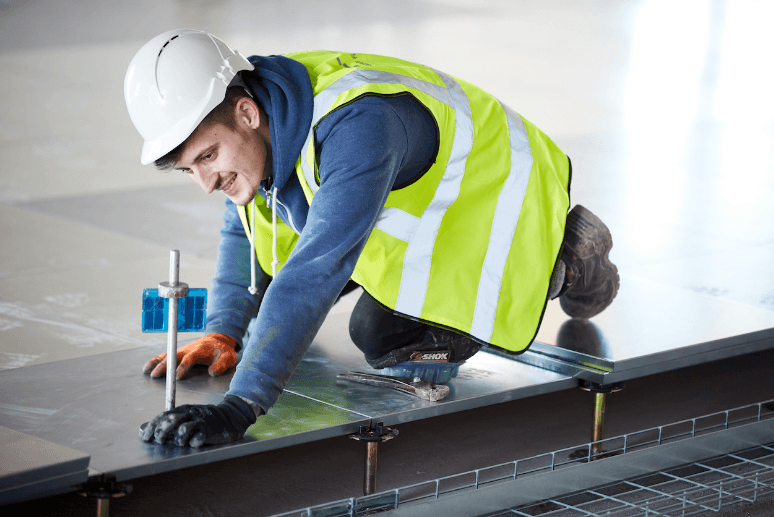
FreeAxez has led this evolution for over 25 years, refining the Gridd system into two primary profiles: Gridd40 at 1.6 inches and Gridd70 at 2.75 inches. Both are engineered specifically for cable and power management, a distinction that shapes every sustainability advantage the system delivers.
The Sustainability Case, Built Layer by Layer
The environmental benefits of low-profile raised flooring aren’t incidental. Gridd was designed to meet the specific challenges posed by the construction industry’s move toward a circular-economy business model.
Material efficiency starts with the choice of materials. Gridd assemblies are made from 100% recyclable steel, are GreenSpec-listed, and are fully modular. Rather than consuming virgin materials with every office refresh, the system is designed for reuse. The floor can move with the tenant, adapt to endless new configurations, and avoid the typical end-of-life cycle of a flooring system.
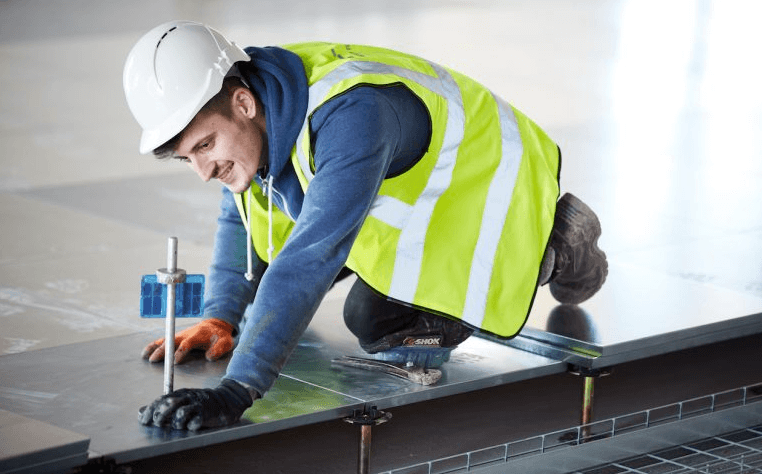
Waste reduction continues with the installation process. Gridd base units are gravity-held and tool-free, which means no adhesives, no special fasteners, and virtually no construction debris during installation or reconfiguration. Traditional hardwired offices generate significant demolition waste every time a layout changes. With Gridd, that cycle is permanently broken. The system is relocatable: when a tenant moves, the flooring moves with them rather than being torn out and discarded.
Energy efficiency operates on two levels. At the infrastructure level, organized underfloor cable management reduces energy waste from poorly routed, heat-generating cable runs. Integration with Gridd Power®, a modular 50-amp bus system, enables precise, scalable power delivery exactly where it’s needed, eliminating the overprovisioning common in conventional builds. At the environmental level, relocating cables from ceilings and walls to an underfloor plenum can reduce HVAC strain by improving airflow distribution and reducing heat load in occupied zones.
Longevity and futureproofing may be the most underappreciated sustainability benefit of all. A building that can adapt to new technology without major renovation stays in productive use longer. Gridd supports LEED and WELL certification credits through material reuse, reduced environmental impact, and improvements to occupant comfort. In short, Gridd is a credible contributor to any green building certification strategy, not just a checkbox.
Aligning Infrastructure with ESG Goals
For organizations with active ESG reporting requirements or net-zero commitments, the financial and operational case for low-profile raised flooring intersects directly with the sustainability case. Gridd components depreciate as equipment rather than building assets in many scenarios, offering accounting flexibility alongside environmental benefits. Reducing renovation frequency lowers both costs and the carbon footprint over a building’s lifecycle. Gridd’s ability to support emerging technologies, such as advanced sensors, smarter energy management systems, and evolving network standards, without structural changes, helps keep the building competitive well into the future.
See also: When to Seek Legal Counsel: Identifying Critical Warning Signs in your Criminal Case
Innovation You Can Stand On
What makes Gridd distinct isn’t any single feature; it’s how the components work together as a complete system. The ultra-low profiles preserve vertical space and dramatically reduce the ramp transitions required by taller systems, keeping floor plans clean and compliant. The modular design means a facilities team can reconfigure power and data outlets within hours rather than scheduling a contractor weeks in advance.
Gridd Power adds another dimension, delivering flexible electrical distribution through modular tracks that integrate directly into the floor system.
The Gridd Mobile® app brings real-time infrastructure visibility to anyone on the build or facilities team, allowing staff to see exactly what’s running beneath their feet without pulling a single panel.
Combined, these elements create an infrastructure platform that grows with the organization rather than constraining it.
Building Forward
For retrofit projects or new construction, Gridd bridges immediate functionality and long-term sustainability in a way few other infrastructure investments can match. It solves today’s cabling problem, supports tomorrow’s technology, and does both without leaving a trail of construction waste or stranded assets behind.
For organizations evaluating how to future-proof their spaces while meeting sustainability targets, the Gridd system offers a straightforward starting point. Contact a Gridd Advisor to learn how the floor beneath your feet can do more than just hold weight; it can provide the foundation for everything your organization needs.